There are moments when life looks perfectly fine on the outside, yet something inside feels unsettled.
You’re doing what’s expected. You’re meeting responsibilities. You may even be performing well by conventional standards. And still, there’s a quiet sense that something is off—an inner friction that’s hard to name.
These out of alignment signs often appear quietly, especially in high performers who are used to pushing through discomfort rather than listening to it.
In my experience, this isn’t a motivation issue or a lack of discipline.
It’s usually a matter of inner alignment.
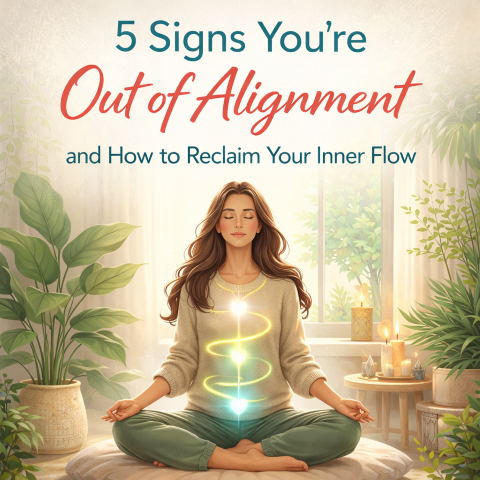
Alignment is the state where your mind, body, emotions, and actions are moving in the same direction. When that coherence is missing, life begins to feel heavier—even when nothing appears “wrong.”
When life feels busy, but not fluid: early out of alignment signs
One of the earliest signs you are out of alignment is the loss of inner flow.
Life continues to move, but it no longer feels fluid. Decisions take more effort. Conversations feel draining. Even simple tasks carry an unexpected weight.
This isn’t because you’re failing.
It’s because your system is working against itself.
When inner alignment is disrupted, energy leaks quietly through resistance, not inactivity.
What inner alignment really means (and what it doesn’t)
Alignment is often misunderstood.
It doesn’t mean constant calm, positivity, or having everything figured out. It doesn’t mean avoiding pressure or challenge.
Inner alignment means internal coherence.
It’s the ability to respond from clarity instead of urgency. To act without forcing. To stay present even under pressure.
High performers and leaders often lose alignment first—not because they lack awareness, but because they spend so much time prioritising outcomes over internal signals.
Sign 1: You’re constantly tired, even when you’re resting
This kind of tiredness doesn’t resolve with sleep or time off.
You may rest, yet still wake up feeling unrefreshed. Your body pauses, but your system doesn’t recover.
This is a common sign of nervous system dysregulation.
When the nervous system stays in a heightened state—mentally alert, emotionally braced, internally rushed—rest doesn’t land. Recovery requires regulation, not more rest.
Reclaiming inner flow begins when the nervous system feels safe enough to slow down.
Sign 2: Decision-making feels heavy or forced
Another clear sign you are out of alignment is decision fatigue.
Choices that once felt intuitive now feel effortful. You overthink simple decisions or delay choices you would normally handle with ease.
When alignment and clarity are lost, even confident leaders experience mental fatigue and reduced inner flow.
This isn’t about capability.
It’s about internal overload.
When alignment returns, decisiveness follows naturally—without force or over-analysis.
Sign 3: You feel emotionally flat or easily triggered
Emotional misalignment often shows up in two ways.
Some people feel emotionally numb—disconnected from joy, excitement, or meaning. Others notice increased irritability, impatience, or emotional reactivity.
Both are signs of chronic stress symptoms affecting emotional regulation.
When inner alignment is present, emotions move through you. When it’s missing, emotions either shut down or spill over.
Alignment restores emotional responsiveness, not emotional control.
Sign 4: You’re productive, but disconnected from meaning
This is one of the most overlooked out of alignment signs.
You’re still productive. You’re still performing. But there’s a quiet sense of emptiness underneath it all.
You’re doing the right things, yet they no longer feel right.
This often happens when action continues long after inner resonance has shifted. Productivity remains, but meaning fades.
Burnout and alignment are closely connected here. Without inner coherence, success begins to feel hollow.
Sign 5: You’re pushing instead of flowing
Perhaps the clearest indicator of misalignment is this: everything begins to feel like effort.
You rely on discipline instead of intuition. You push through resistance. You override inner signals because “this is what needs to be done.”
Flow disappears, and force replaces it.
Inner flow doesn’t remove effort—but it replaces force with cooperation. You still show up, but with far less friction.
How to reclaim your inner flow (without fixing yourself)
Reclaiming inner flow is not about changing who you are.
It’s about restoring alignment across mind, body, and nervous system.
This begins with:
- slowing internal pace before changing external actions
- listening to bodily and emotional signals without judgement
- prioritising nervous system regulation over motivation
- allowing clarity to emerge instead of forcing it
Alignment is not built through effort.
It is restored through awareness and self regulation.
Where Elevaate Alchemy supports alignment
This is where ecosystems like Elevaate Alchemy become deeply relevant.
Elevaate Alchemy supports inner alignment for leaders by integrating nervous system regulation, emotional awareness, and sustainable performance—rather than addressing each in isolation.
When healing, identity, and leadership are supported together, alignment doesn’t need to be chased. Inner flow returns naturally.
Elevaate Alchemy was created for those who have done a lot of inner work, yet still feel fragmented—strong in one area of life and misaligned in another.
Integration changes that.
Why alignment matters for leaders and high performers
For leaders, misalignment rarely stays personal.
It affects:
- decision quality
- leadership clarity
- emotional presence
- the nervous systems of teams and organisations
Aligned leaders don’t just feel better internally. They create calmer, more sustainable systems around them.
Alignment becomes the foundation of sustainable performance, not intensity or control.
If you recognise yourself in these signs, nothing is wrong with you.
You’re not broken.
You’re not failing.
You’re not behind.
You may simply be out of alignment.
Learning how to reclaim inner flow is less about fixing yourself and more about restoring coherence within your system.
When alignment returns, flow follows—quietly, naturally, without force.
That’s not something you achieve.
It’s something you remember.
